
 |
||||
| Click on the picture to the left to see more pictures. | ||||
Weight: 1.5 lbs - 3 lbs
Life Span: up to 25 years
Physical Characteristics:
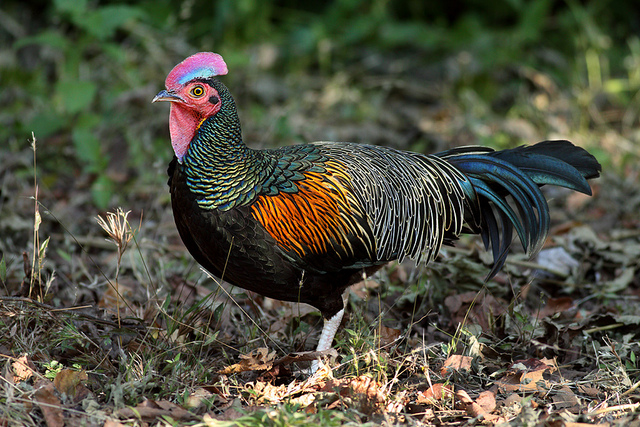
The colouration of the Green Junglefowl is sexually dichromatic. The male's plumage is dark and blackish at a distance. A closer view will reveal an iridescent mantle of gleaming scales reminiscent in color and pattern to those seen in the Ocellated Turkey and Green Peafowl. Each scale is vivid blue at its base and moves through various shades of gold and bronzed green. Specialized plumes framing the throat of the male Green Junglefowl are highly light reflective and appear violet at the proximal and sky blue at the distal edges. The lesser coverts of the wing are a striking burned orange with bronzed black centers. The distal edges of the greater secondary coverts are vivid ocher. Like its cousin the Red Junglefowl, the breast and ventral regions are a dense light absorbing black. Like its closer relative the Ceylon Junglefowl, the male Green Junglefowl exhibits vivid 'windows' of bare facial skin that contrasts against the dark scarlet red of the face. The Green Junglefowl exhibits an ice blue center in its comb. A region of electric yellow facial skin extends below each ear, delineating the plumed hackles from gular lappet. Its head is topped by a light blue comb, which turns purple or red towards the top. Its wattle is also of the same color but is bordered with blue on the edges and yellow closer to the throat. The female is mostly brown with occasional green feathers and has no comb.
Behavior:
The Green Junglefowl usually lives in groups of two to five in the wild led by a dominant male, who takes the flock to feed and drink and then back into the cover of the forest. In the night the flock roosts in bamboo stands at 15–20 feet above the forest floor. In the breeding season the dominant males in each flock are challenged by other males within other flocks. The two males clap their wings and crow loudly while fighting each other with their spurs. The junglefowls breeding season is Mid-April to June producing anywhere from 5 to 10 eggs. There incubation period takes about 21 days. Some junglefowl are fertile there first year, but they are not fully mature untill there second year.
Diet:
The green junglefowl basically eats what a chicken eats. They mostly eat corn, wheat, vegetables, insects, seeds, frogs, and sometimes littered food.
Predators and Threats:
The green junglefowl is generally considered common and widespread despite habitat loss and poaching within its range. The junglefowl is affected relatively little by habitat loss because it can occupy a variety of habitats, including secondary vegetation and man-made habitats, such as rubber and oil-palm plantations and planted fields on forest edges. However, it has recently come to light that genetic contamination through interbreeding with domestic and feral chickens poses the real threat, pushing pure wild junglefowl to the verge of extinction. Eclipse plumage, one of the indicators of pure stock, is now only seen in populations in the western and central regions of the species' geographic range, and it is therefore feared that the pure form of this colourful bird has disappeared completely. Due to the high density of the human population, whose domestic chickens could continue to contaminate the red junglefowl genetically, the purity of the species, where it remains, is in constant danger.
Habitat:
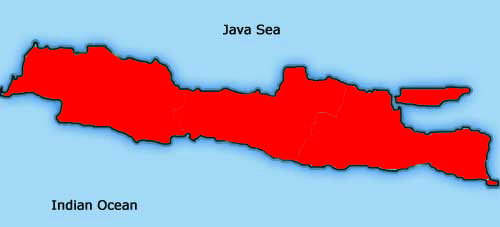
The green juglefowl is native to Java, but now it is getting to be more widely disperesed.
 |
|||
 |
|||